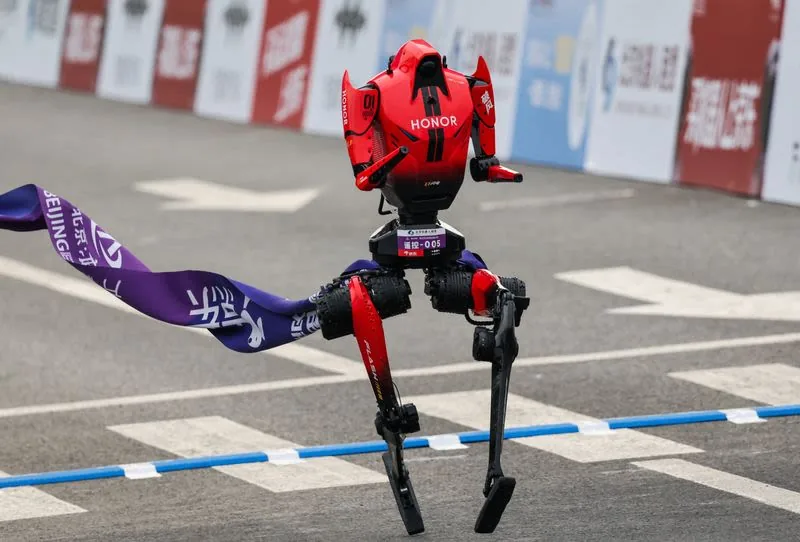
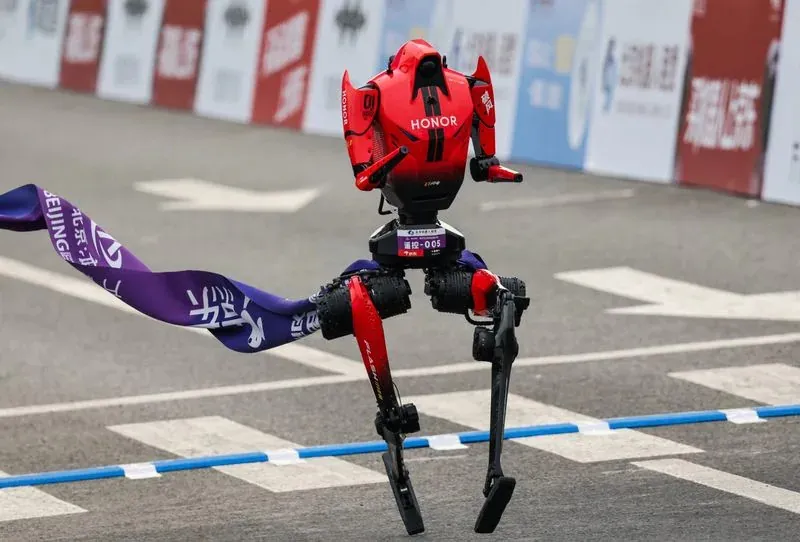
Robots at the World Humanoid Robot Games in Beijing have surpassed Usain Bolt‘s 100-meter dash record. During a preliminary heat on Saturday, a Chinese humanoid robot completed the 100 meters in 9.39 seconds, a time faster than the men’s world record held by the Jamaican sprinter.
The robot, named Tiangong Ultra, developed by the Beijing Humanoid Robot Innovation Center, secured victory in its heat at the opening of the games’ second edition. Another robot, Lightning, from smartphone maker Honor, also finished the 100 meters in 9.47 seconds, which is also faster than Bolt’s 9.58-second record from the 2009 World Athletics Championships in Berlin.
Record-breaking performances
Prior to the official opening of the games, Honor’s Lightning robot achieved a 100-meter sprint in 9.32 seconds during a trial, reaching a peak speed of 14.5 meters per second. This performance was reported by Chinese state media earlier on Saturday. In the official heat, Lightning initially led before Tiangong Ultra overtook it near the finish line.
Both robots concluded their sprints by colliding with a mat designed to halt them. Tiangong Ultra reportedly stumbled into the sidelines, requiring onlookers to move, while Lightning was carried away on a stretcher after collapsing. These results represent a significant improvement compared to the inaugural games last year, where Tiangong Ultra won the 100 meters in 21.50 seconds.
Beyond the 100-meter dash, the games showcased other impressive robotic feats. In a standing high jump event, a humanoid robot achieved a height of 2.88 meters. This mark significantly exceeds the 0.95 meters achieved by a humanoid in the previous year’s games and also surpasses the human high jump record of 2.45 meters set by Cuba‘s Javier Sotomayor in 1993.
Lightning also participated in and won this year’s humanoid half-marathon, completing it in 50 minutes and 26 seconds. This time is faster than the pace of the elite men’s human world record for a half-marathon. For this event, Lightning stood 169 cm tall with 95-cm legs. Its researchers later extended its legs by 10 cm, to 1.05 meters, in preparation for the games.
Expanding scope of the games
The World Humanoid Robot Games, now in its second year, features more than 2,000 robots competing across 51 events and 1,000 competitions. These events include running, table tennis, soccer, football, dancing, industrial-task contests, weightlifting, and tug of war. The five-day event highlights China’s advancements in robotics amidst a competitive global technology landscape.
The games are being held at the National Speed Skating Oval, a venue originally constructed for the 2022 Winter Olympics. This year’s event has attracted 2,056 robots from 666 teams, representing 16 countries and six continents, a notable increase from the 280 teams that participated in the inaugural event. Participating countries include Germany, Japan, and the U.S.
The games coincide with the 2026 World Robot Conference, also taking place in Beijing during the same week. At this conference, various companies showcased approximately 3,000 products, including humanoid robots. China views humanoid robots as a strategic emerging industry, with policymakers and companies anticipating that progress in artificial intelligence and hardware will accelerate their adoption in manufacturing, logistics, and consumer applications.
Investor interest in the sector was evident earlier in the week when shares of Unitree, a prominent Chinese humanoid robot manufacturer, saw a substantial increase of more than five-fold in its Shanghai trading debut on Wednesday, resulting in a market value of approximately $50 billion.
International perspectives
Spectators at the robot games expressed enthusiasm for the rapid improvements in humanoid robot capabilities. Li Yanfeng, an education worker and Beijing resident, noted the quick evolution of humanoid robots. She initially had reservations about artificial intelligence due to concerns about human displacement but now sees the development as unstoppable.
Another spectator, Yang Shangzheng, found it amazing that robots can now perform sports considered normal for humans. Liu Tao, attending with his son, hoped to observe the best robots China currently offers. The games are scheduled to run through Wednesday.
The U.S. has increased its scrutiny of robots originating from China, which produces the majority of the world’s humanoid robots. The Federal Communications Commission (FCC) under President Donald Trump has banned imports of new foreign-made humanoid robots, citing unacceptable risks to national security and the safety of United States persons. FCC Chair Brendan Carr stated that the FCC has added foreign-produced advanced robotics and power inverters to its Covered List, aligning with national security agencies to secure America’s critical supply chains.
Source: foxnews.com

Mason Reed
Sports reporter covering football, basketball and international competitions.