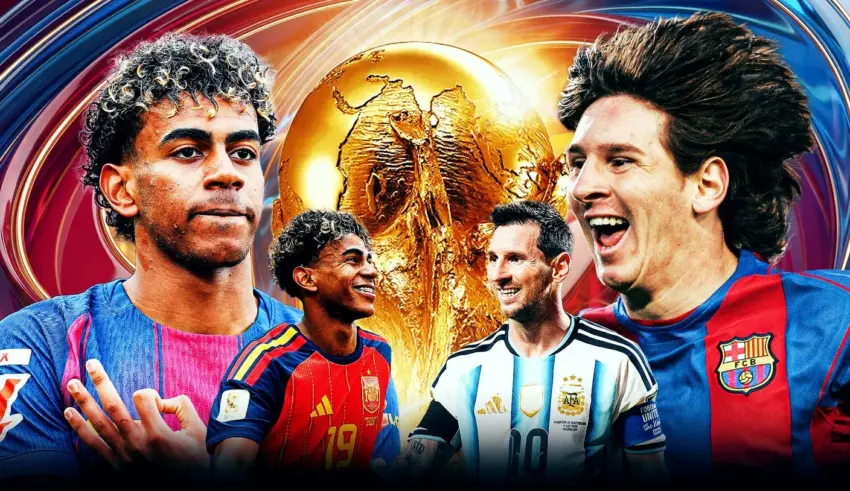
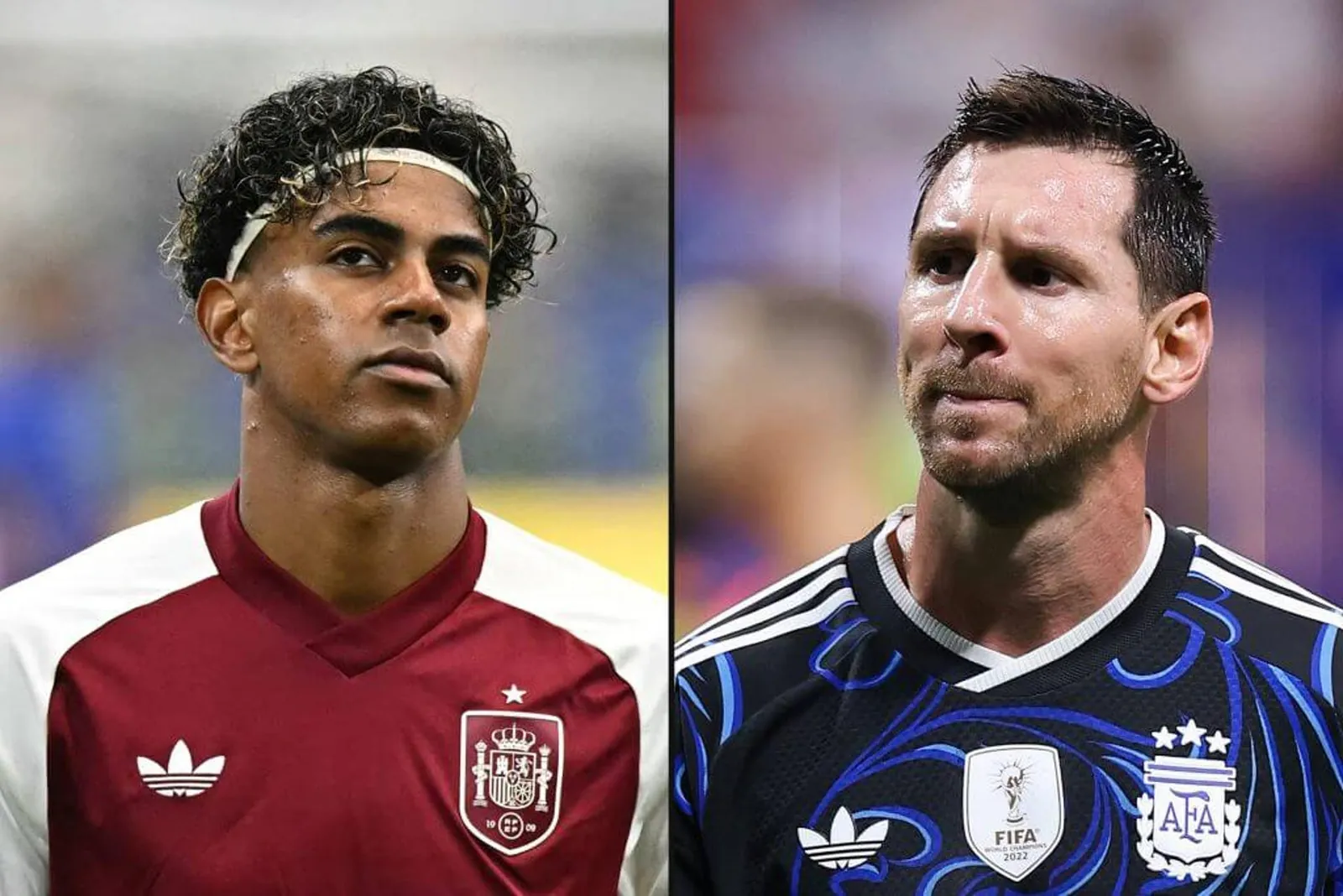
The World Cup final is set to take place at MetLife Stadium, featuring a match between Spain and Argentina. This encounter brings together Europe’s champions and their South American counterparts. The game will see Lionel Messi, at 39, face Lamine Yamal, 19, who is considered a potential successor to Messi’s legacy at Barcelona.
While this marks their first on-pitch meeting, a notable connection between the two players dates back to December 2007, when Messi participated in a charity photoshoot that included a five-month-old Yamal.
Spain’s Path to the Final
Spain’s journey to the final began with a surprising goalless draw against Cape Verde. They subsequently found their form, securing a 4-0 victory over Saudi Arabia, with Mikel Oyarzabal scoring twice and assisting Yamal, alongside an own goal from Hassan Altambakti. A 1-0 win against Uruguay, thanks to Alex Baena‘s goal, ensured they topped Group H.
The team’s performance improved as key players like Yamal and Rodri regained full fitness. Spain advanced with a 3-0 win over Austria in the round of 32, where Oyarzabal scored a double and Pedro Porro added another goal. The last 16 saw them defeat Portugal 1-0 with a 91st-minute goal from substitute Mikel Merino, marking the end of Cristiano Ronaldo‘s World Cup career.
In the quarter-finals, Spain overcame Belgium 2-1, a match where a mistake by Belgium’s goalkeeper Senne Lammens contributed to Merino scoring late. Their most significant challenge came in the semi-final against pre-tournament favorites France. Spain delivered an impressive performance, with Rodri helping to control the midfield and frustrate French attackers Kylian Mbappe, Ousmane Dembele, and Michael Olise. Yamal earned a penalty converted by Oyarzabal, and Dani Olmo set up Porro for a second-half strike, sealing a 2-0 victory.
Argentina’s Resilience and Messi’s Influence
Argentina’s progression through the tournament has been characterized by resilience. They navigated the group stage comfortably, winning 3-0 against Algeria. However, the knockout rounds presented more significant challenges. In the last 32, they were pushed hard by Cape Verde, and in the last 16, they came back from a 2-0 deficit against Egypt. Their quarter-final against Switzerland saw them in trouble before Breel Embolo received a red card. Argentina also secured a semi-final victory over England from a precarious position.
Messi’s impact has been crucial for Argentina, contributing eight goals and four assists. The team, managed by Lionel Scaloni, has also demonstrated a knack for weathering storms and scoring late goals, with 12 of their 19 goals arriving after the 75th minute of normal time. Argentina is defending the title they won in 2022, aiming for their third overall, in what is widely anticipated to be Messi’s final World Cup appearance.
Messi’s departure from Barcelona in 2021, due to financial instability and La Liga’s financial regulations, had a ripple effect. This event, coupled with his move to Inter Miami after a period with Paris Saint-Germain, is seen as contributing to Argentina’s continued strong performance and Spain’s emergence of young talent, including Yamal. His time in Miami is described as bringing him happiness, which has strengthened his connection with the Argentinian national team and its community.
Tactical Approaches and Key Players
Spain is expected to showcase a possession-dominant, short-passing style, having averaged 63.7 percent of the ball across their seven matches. Their approach involves dynamic movement, with players interchanging positions and full-backs making deep runs into advanced areas, as exemplified by Porro’s goal against France. Spain’s commitment to controlling possession is complemented by an aggressive press to win the ball back, with center-backs Pau Cubarsi and Aymeric Laporte maintaining a high defensive line. Rodri is central to their midfield, sweeping up loose balls and preventing counter-attacks.
Argentina, while relying heavily on Messi’s individual brilliance, is characterized by a combative and resilient attitude. Their ability to come alive late in games is a key feature. They tend to concentrate their attacking combinations through the middle, where Messi operates, directing a smaller share of their passing towards the flanks compared to other teams. While Messi’s physical limitations mean they do not employ the same aggressive high press as Spain, they are adept at sitting off before engaging in challenges.
The World Cup final is scheduled for Sunday, July 19, with kick-off at 12pm PT/3pm ET/8pm BST.
The match will be broadcast in the United States on Fox (English) and Telemundo (Spanish), in Canada on TSN/RDS, in Mexico on Televisa Univision/TV Azteca, and in the United Kingdom on BBC One/ITV. Streaming will be available in the U.S. via Fubo.
Spain, ranked 2nd by FIFA, is looking to win the World Cup for a second time, 16 years after their first success. Argentina, ranked 1st, is aiming to win back-to-back World Cup trophies, a feat achieved by only two other national teams.
Yamal, upon entering the pitch in New Jersey, will become the third-youngest men’s player to participate in a World Cup final, following Pelé and Giuseppe Bergomi.
The historical connection between Messi and Yamal, and the role of Barcelona’s academy, La Masia, in nurturing both players, adds a unique narrative to this final. Messi’s departure from Barcelona in 2021 led to the club relying more on its academy graduates, including Yamal, who joined the senior team in the 2022-23 season.
This match is poised to be a significant event, with both teams bringing distinct strengths and compelling storylines to the global stage on Sunday, July 19.
Read Also
- Royal Birkdale: McIlroy plots Open comeback after challenging first round
- Donald Trump questions Thomas Tuchel's tactics in England's World Cup semi-final loss
- White responds to McGregor's call for Holloway rematch after injury
- Aaron Judge's rib injury not fully healed, still not cleared for baseball activities
Source: nytimes.com

Mason Reed
Sports reporter covering football, basketball and international competitions.