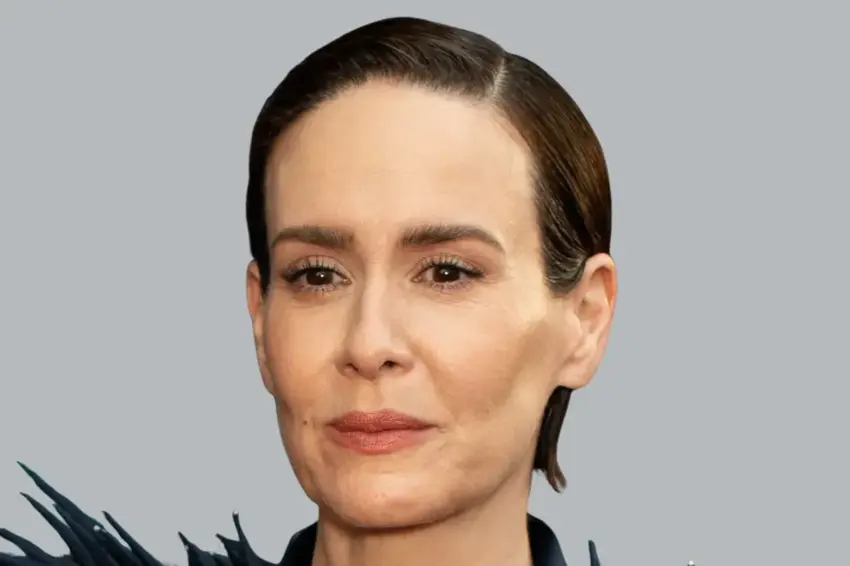
At the 2026 Met Gala, Sarah Paulson turned heads with a striking look: a money blindfold paired with a custom gray tulle gown by Matières Fécales. The event, held at the Metropolitan Museum of Art in New York City, is known for its blend of high fashion and celebrity glitz, but this year it took a sharp turn into political territory.
Paulson’s ensemble—titled “The One Percent”—was meant as a bold statement against extreme wealth. With tickets reportedly costing $75,000 and ultra-wealthy figures like Jeff Bezos and Lauren Sanchez co-chairing the event, her choice felt particularly pointed. Critics quickly labeled her look as “tone deaf,” arguing that making a political statement at an event celebrating the affluent was inappropriate.
Key aspects of Paulson’s look:
- Money blindfold symbolizing wealth inequality
- Custom gown from Matières Fécales’ A/W 2026 collection
- Styled with white opera gloves and Boucheron jewelry
This year’s theme was “Costume Art,” which invited attendees to push boundaries in how they express themselves through fashion. Yet, some felt that Paulson’s approach crossed a line. “You wanted a statement at the Met Gala? Well here you go,” quipped one social media user, while others echoed sentiments of confusion over the juxtaposition of glamour and activism.
Fashion houses like Matières Fécales defend such choices, emphasizing that true art—and especially fashion—is political. “Fashion is Art and at its most daring, Political,” they declared, framing Paulson’s look as part of a larger conversation about societal issues. But does wearing such a statement piece truly resonate when surrounded by extravagance?
As discussions continue, Taraji P Henson expressed her bewilderment: “I am so confused by some people that are going to the Met Gala this year.” It raises questions about intent versus impact in fashion activism—especially when so many attendees embody the very wealth Paulson sought to critique.
The Met Gala remains a fundraiser for the Metropolitan Museum of Art, yet its role as a platform for social commentary grows more complex each year. As celebrities navigate this delicate balance between art and activism, the lines blur further—leaving audiences to ponder: Can fashion truly inspire change?

David Miller
David covers technology, science, and innovation from around the world.