Lionel Messi’s World Cup career appears to have concluded with a defeat in the final against Spain, who secured a 1-0 victory. The match, held at MetLife Stadium, saw Spain claim their second World Cup title, while Argentina’s quest for a fourth star ended in disappointment. Messi, at 39 years old, was observed to be isolated on the field following the final whistle, a stark contrast to the celebrating Spanish squad.
The atmosphere at MetLife Stadium was electric, with tens of thousands of fans present and billions watching globally. Despite the immense support for Argentina, Messi’s presence on the field was largely contained by Spain’s defense. He touched the ball only once in the initial 15 minutes of the game, and Unai Simon, Spain’s goalkeeper, did not need to make a save until stoppage time in the first half.
A Familiar Pattern of Defeat
The final mirrored a pattern seen in the 1990 World Cup final, where Argentina, then champions, faced West Germany. In that match, Argentina failed to register a single shot on target and ultimately conceded a penalty in the 85th minute. Similarly, in the recent final, Spain’s persistent attacks eventually broke the deadlock. When Ferran Torres scored the decisive goal, Messi reportedly fell to his back, sensing the game’s outcome.
Argentina’s coach, Lionel Scaloni, acknowledged the team’s inability to compete head-to-head with Spain. The team also faced challenges with player discipline, as Enzo Fernandez received a red card, leaving an already fatigued squad shorthanded for extra time. This marked the third instance in the tournament where Argentina was taken to extra time.
Following the final whistle, Ferran Torres was the first player to reach Messi, who remained by himself as his teammates were involved in an altercation. Leandro Paredes was noted to be at the center of this incident. Despite the loss, chants of “ME-SSI, ME-SSI!” resonated through the stadium as fans expressed their support and denial.
Messi’s Legacy and Emotional Farewell
Messi led his team to receive their runners-up medals from U.S. President Donald Trump. He was visibly emotional, weeping as Spain lifted the trophy. A banner displaying Messi and Diego Maradona with the caption “symbiosis” fluttered in the wind, highlighting the deep connection between Messi and Argentina’s footballing heritage.
This final appearance marked Messi’s sixth World Cup, and it is widely considered his last. His career has been characterized by significant achievements, including Argentina’s Copa America win in 2021 and the World Cup victory in 2022. Despite the loss, Messi’s impact on the sport and his national team remains profound, with many records attributed to him.
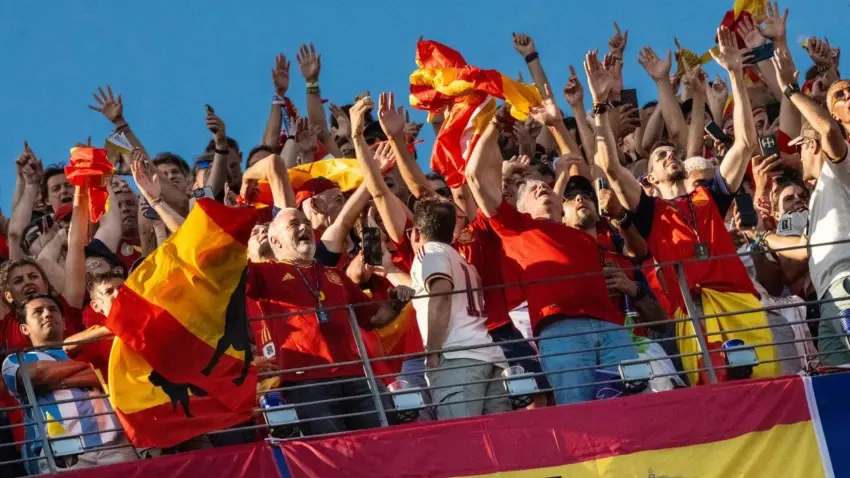
The Spanish team, after their victory, is scheduled to return home to Madrid for a royal welcome and a parade. The 26-man squad will be greeted by King Felipe VI and Prime Minister Pedro Sánchez before embarking on an open-top bus parade through central Madrid, culminating in a ceremony at Cibeles Square. This triumph marks Spain’s second World Cup title, following their 2010 victory in South Africa.
The win also makes Spain the first nation to simultaneously hold both the men’s and women’s World Cup titles, with the women’s team having won in 2023. Celebrations in Madrid were widespread, with thousands of supporters filling the streets. However, the festivities were marred by a report of a 13-year-old’s death in Salamanca due to a fountain collapse during celebrations.
For many young Spanish fans, this is their first experience witnessing the men’s team win the World Cup, leading to widespread national excitement. Fans gathered at Madrid’s Barajas airport and Cibeles Square, some bringing umbrellas to cope with temperatures expected to reach 35 Celsius.
Read Also
Source: nytimes.com

Mason Reed
Sports reporter covering football, basketball and international competitions.